

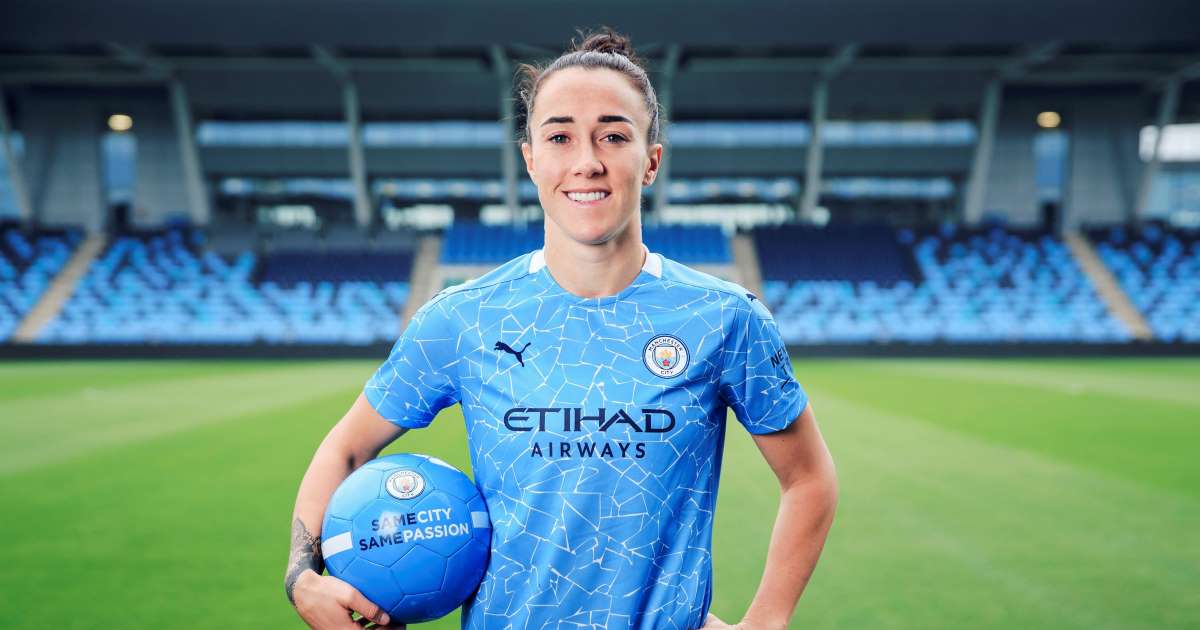
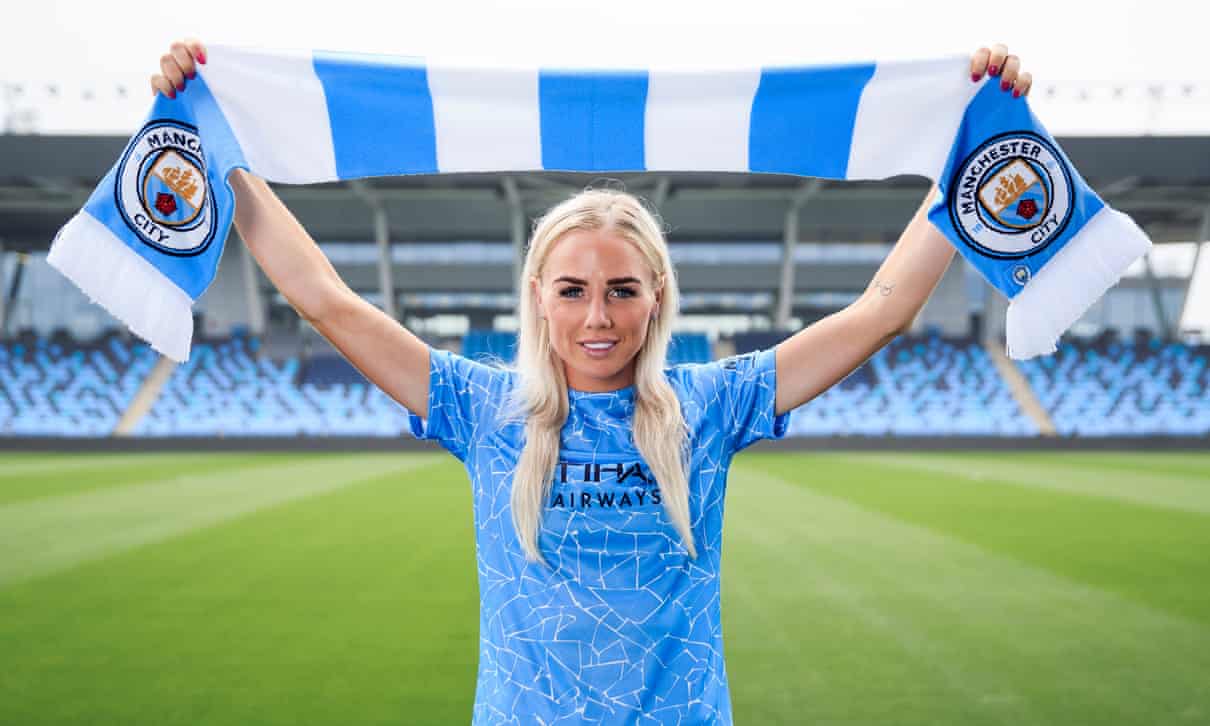
Defensive Duo: Lucy Bronze and Alex Greenwood’s recent return tells us a lot about the status of the WSL. Photograph: Matt McNulty – Manchester City/Getty Images.
The Women’s Super League is back. The hive of transfer activity has reached its climax and the ping of twitter notifications hailing the next summer signing has transcended social media to act as a statement of intent for the season ahead. Like all seminal moments the first question one must ask is simple: where were you when it happened? Thankfully, for fans across the globe the female footballing revolution in England is unfolding now – rising towards a crescendo. Despite this ascent appearing sudden, the reality behind its progression is far more painstaking.
The nine years since the FA Women’s Super League inception in 2011 has been characterised by a gathering of pace; momentum bubbling away in the background, and luckily for the spectator it has finally erupted to the forefront to snatch centre-stage. The process behind the scenes to develop a WSL brand that is recognised globally can be likened to attributes that are often rewarded on the pitch itself: hard work, passion and overcoming adversity. The continued efforts to promote the WSL are perhaps one of the reasons it has now forged an identity as one of the best leagues in the world, with the plethora of talent arriving in England ahead of the new 2020/21 season a clear testament to those who have been committed to unshackling women’s football from its previous, dormant state to realise its potential. So, what makes this year so different?
When Lucy Bronze left Manchester City in 2017 for French giants Lyon the explanation was a straightforward one. Lyon had already won three coveted Champions League titles and had the resources and appetite for more. The English club on the other hand, had yet to challenge for European glory despite exerting dominance domestically. Bronze even admitted on her departure that: “The standard across Europe is set by Lyon”. She was certainty right. Fast forward three years and Lyon’s European dominance is unquestionable. Seven Champions League Titles since 2011 and five coming in successive seasons is a feat that will surely prove difficult to replicate. As the French side continue their relentless domination, it is no surprise that other English players such as, Alex Greenwood and Nikita Parris saw a switch to Lyon and the French League, Division 1 Féminine, as an integral part of their professional development.
But things have changed. Both Lucy Bronze and Alex Greenwood have returned to WSL action with Manchester City emerging as the destination for the defensive duo. Their cyclic journeys have found them back in the WSL and it is no surprise. The English league is reaping the rewards of investment and commitment and I am certain that we will see a decline in the school of thought that elite development can only be achieved abroad. The WSL is no longer seen as a springboard to catapult players onto bigger or better leagues to achieve their potential. The WSL is now a competitive platform on which to perform.
If there is any doubt about the league’s status, one just has to look at the recent recruitment. Currently sixty-two players have been brought into the league. Among them: World Cup winners; Champions League winners; and Ballon d’Or nominees. Highly decorated athletes, whose calibre is unquestionable and mentality is accustomed to the addictive nature of winning. Take for instance, Rose Lavelle. World Cup winner, star of the USA national team and more recently a Manchester City player. A player who was drawn to the league to develop, as she explained in her recent interview:
“It was all very appealing to me and something I felt like was going to make me better. I think it’s just an environment that I felt I was going to be constantly learning in.”
We should take what Lavelle says seriously. A World Cup winner has weighed up her options and decided that the English league is the best place to challenge herself. If this isn’t a sign of a league that’s primed to become the best, it’s difficult to understand what is. It’s not just Lavelle who is bringing her exciting talent to the league. Manchester United completed the signing of USA duo Tobin Heath and Christen Press yesterday, while Chelsea set the tone with the signing of Pernille Harder from Wolfsburg; the most expensive female player. The list of world-class signings is endless, and undoubtedly the melding of talent and experience across the league will ensure it lives up to its high expectations.
The WSL has come a long way since 2011. The success we are witnessing now is the outcome of an organisation that has evolved, while ensuring the core vision of growing the women’s game is retained. The investment by Barclays in 2019 did more than simply change the title of the league to the ‘Barclays FA Women’s Super League’. Its impact is much wider. It highlights a commitment to making football accessible for girls, to forging an elite league in England and driving the growth of the women’s game. Add to this, a recent deal to broadcast the WSL in Germany, Italy and the USA on NBC sports, along with the BBC’s new Women’s Football Show and you can see why the excitement for this league is justified.
This year is a defining moment. This year, English sides will challenge the likes of Lyon for European glory. Excitement is not just allowed. It is actively encouraged.
 SPORT central